education culture, nft, resources
The Metaverse Architecture: An Infographic By Dinis Guarda
Dinis Guarda,Dinis Guarda Infographic,Infographic,Metaverse,Metaverse Infographic,NFT infographic,NFTs,The Layers Of The Metaverse In An Infographic
08 Jul 2022

The Metaverse and the new generation of the internet, Web 3.0, are already here. But what exactly is Metaverse? Here’s an infographic that explains all the layered framework of the metaverse: a metaverse that is distinct in architecture and simple in existence.
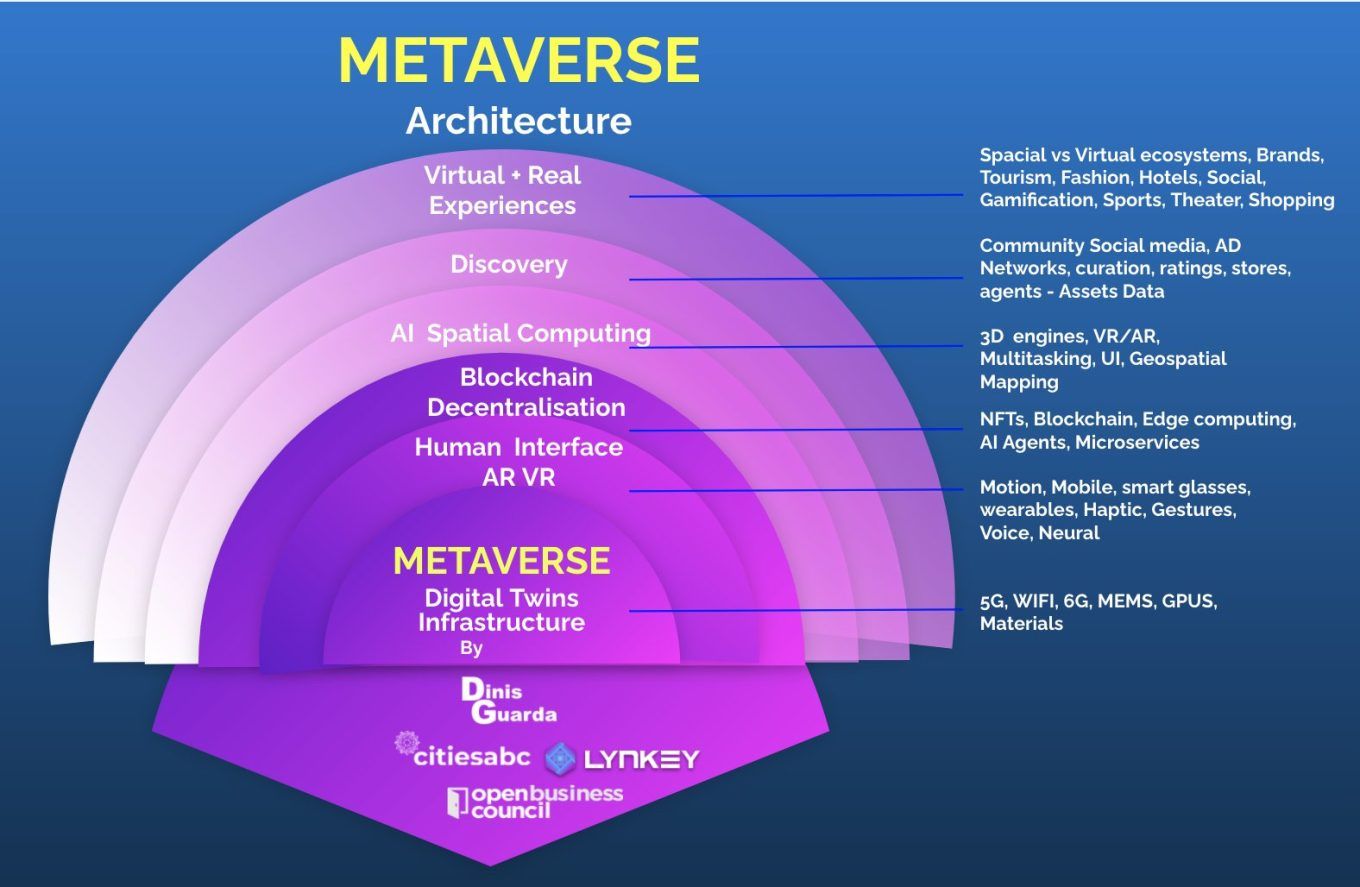
With a projected market of $800 billion, Metaverse is the next big revolutionary technology that is attracting almost every segment of the business. A metaverse is a network of 3D virtual worlds that is centred on social connections made by its participants.
Characterised as a simulated digital environment, Metaverse incorporates technology like augmented reality (AR), virtual reality (VR), Internet of Things (IoT), 5G, artificial intelligence (AI), and blockchain.
All this, and a realm built on the principles of social media creates a sphere that resembles the real world very closely.
Metaverse is this self-contained virtual economy that is powered by digital currencies and non-fungible tokens (NFTs).
“The metaverse is best understood as the shift of computing and interaction from a device in your pocket into a virtual simulation.” – Matthew Ball, author of “The Metaverse”.
Obviously, there is a need to know this immersive virtual space deep down the intrinsic layers of its architecture, to the very core.
With his expertise in digital and technological advancements and creativity, Dinis Guarda, (title) explains Metaverse to be layered. Here, he follows a systematic approach to describe the framework of the technology.
Let’s dig through these layers and find out the very essence of the Metaverse.
Experience (Virtual and Real)
Most people, while thinking of the metaverse, focus on this layer- the experiences of interacting while engaging in digitally-driven landscapes, like shopping, games, NFTs, digital media, NFTs, etc.
Perhaps, the popular culture of gaming best describes the features of this evolution- avatar identities, virtual immersion, storytelling, and other social interactions.
Besides this, volumes of data could be generated through everyday experiences too, like office meetings, gym workouts, cooking, tourism, theatre, holiday, or even classroom sessions could be classified under this layer.
Discovery
The information and data are collected either through inbound or outbound sharing or marketing systems.
Inbound discovery includes platforms that are involved in community content. In other words, the places that hold public information of the likes and recommendations by the users are responsible for the inbound discovery, like the social networking sites, app stores, and even search engines.
Outbound discovery, on the other hand, includes notifications and display ads.
In the metaverse, the real-time presence of the users would generate additional data about their physical and social ‘immersiveness’. For instance, during a virtual tour of a property, the systems track a user’s choices, preferences, and dilemmas.
Spatial Computing
It is the technique that blurs the boundaries between the real physical and the virtual world. In other words, constantly blends the two intersecting spheres by manipulating 3D online spaces into uncanny realism, or augmenting the real world with digital experiences.
Advanced technologies like 3D programs and engines, geospatial mapping, AR/VR, and XR have proved useful for spatial computing. Biometric applications, voice recognition, and even gesture recognition are some of the verticals of IoT gaining traction to leverage spatial computing and make the metaverse look more real.
Decentralisation
The key to a successful metaverse lies in its open, decentralised, and distributes nature. With the momentum that blockchain technology has gathered over the past decade, it seems plausible that open-source platforms, smart contracts, a sovereign digital identity, DeFi protocols, and dealing in NFTs are soon to be a consensual choice of the metaverse.
AI agents, Microservices and Edge Computing are going to be the latest trends.
Human Interface
The human-technology interface is getting more illustrious by the day. VR headsets, AR smart devices, neural networks, smart glasses, and other wearables are enhancements to smartphone devices. These merely enhance the human body with digital capabilities.
Digital Twin Infrastructure
It encompasses all the technology that is capable of enabling, connecting, and empowering digital devices. The ultimate goal is to realise the potential earthed within each layer. Data centers, wireless, cloud computing, and related materials and processes make up the infrastructure for digital twin technology.
The Metaverse is already here
With an explosion of technological advancements over the past few years, we are already experiencing the ingression of the metaverse in our lives. Nevertheless, there is still a lot to be learned and evolved. The basic infrastructure already laid down by the wealth of knowledge from thinkers and the pioneers in the metaverse shines brightly to guide humanity towards better frontiers (that are yet to be explored).


