

Revealed: Middleweight Cities To Drive Global GDP And Population Growth By 2025
Research
14 May 2019

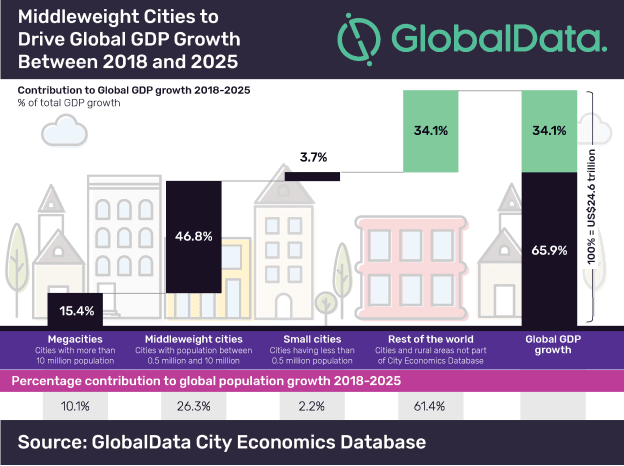
Megacities (population over 10 million) are becoming over populated and as a result are plagued with housing, transport and infrastructure problems. Against this back drop, ‘Middleweight cities’ – those with a population between 0.5 million and 10 million – will drive the world’s economic and population growth by 2025, according to GlobalData, a leading data and analytics company. According to the company, middleweight cities were home to 2.33 billion people and contributed 50.5% to the global GDP in 2018. By 2025, the population in middleweight cities is expected to grow by 143 million people, 86.3% of which will come from middleweight cities of the developing world. Tarun Bisht, Economic Research Analyst at GlobalData, says:
“High income inequality has led to the creation of mega slums in megacities. Environmental concerns are also slowing down migration into these cities. For instance, rising PM2.5 (atmospheric particulate matter that has a diameter of less than 2.5 micrometers) concentrations in large Chinese cities such as Beijing and Shanghai may affect the recruitment of skilled human capital and the cities’ competitiveness in the future.”
Middleweight cities – New engines of economic growth
GlobalData forecasts that between 2018 and 2025, middleweight cities will contribute 46.8% to the world GDP growth. Out of which, middleweight cities from the developing world will account for 29.1% of the world’s GDP growth, while middleweights from the developed world will contribute 17.7% between 2018 and 2025. Ten middleweight cities will have GDP over US$0.5 trillion with
with GDP close to US$0.85 trillion, followed by Dallas (US$0.81 trillion), San Francisco (US$0.71 trillion), Washington (US$0.68 trillion), Houston (US$0.63 trillion), Boston (US$0.59 trillion), Seattle (US$0.54 trillion), Philadelphia (US$0.54 trillion), Atlanta (US$0.52 trillion) and Hong Kong (US$0.51 trillion) by 2025. Furthermore, ten of these middleweight cities namely Bogota, Cairo, Chennai, Handan, Hangzhou, Harbin, Hyderabad, Luanda, Qingdao and Quanzhou will become megacities by 2025.
Affordable alternative to megacities
Dominant middleweight cities such as Berlin and Cologne in Germany, Dublin in Ireland and Manchester and Liverpool in the UK are either capital cities or regional economic and financial hubs. GlobalData forecasts these cities to outperform some of the megacities in terms of economic, demographic and income growth. Bisht adds:
“The growth of middleweight cities is fueled by an abundance of natural resources, demographic advantage, strategic geographical location, large consumer base, tourism opportunities and the presence of economic clusters. Several middleweight cities have a high degree of industrial specialization, thereby attracting a skilled workforce and driving productivity growth. Moreover, such cities are preferred destinations due to relatively lower cost of living compared to megacities such as London, New York, Los Angeles and Tokyo.”
Growing consuming class to give edge to middleweight cities
With a rise in employment and income levels, spending power is expected to increase thereby resulting in the expansion of the urban consuming class. GlobalData predicts these middleweight cities to be home to approximately 582.5 million households having an average income of more than 20,000 Int'l$ purchasing power parity (PPP) by 2025. Consumer spending in middleweight cities is forecast to rise from approximately Int'l$21.3 trillion (PPP) in 2018 to Int'l$27.1 trillion (PPP) by 2025, with 50% of it coming from middleweight cities in developing economies. Bisht concludes:
“To remain competitive, middleweight cities should focus on infrastructural development and technological innovations, thus making these cities attractive locations for businesses and skilled work force.”


