

circular economy business
London's Remote Jobs Upsurge 'Risks Widening Inequality', New Report Finds


- London’s resilient remote-friendly professional sector could harm lower paid service industries long after lockdown
- New data shows London has recorded uninterrupted growth in remote working jobs during the pandemic, even when these jobs declined elsewhere in the UK
- Trend recorded across Europe’s four largest capitals – Berlin, London, Madrid and Paris – and risks aggravating urban inequality
- Rising remote working may persist longer in capitals than elsewhere, creating an urgent need for local policies to help the urban workforce navigate change, according to new findings from the OECD and the world’s largest job site Indeed
The resilience of professional roles in London – in which work can largely be done remotely – could prove the undoing of the capital’s service industry, according to new research by the OECD’s Center for Entrepreneurship, SMEs, Regions and Cities and the world’s largest jobs site Indeed.
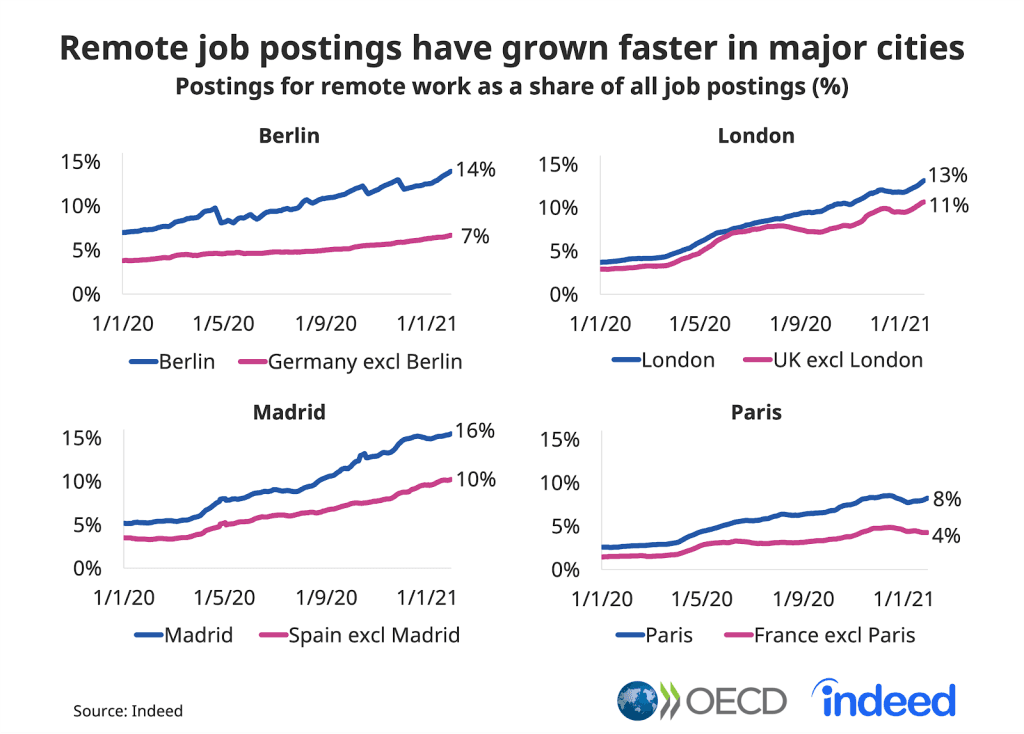
London recorded uninterrupted growth in remote working roles during the pandemic, which continued even as the share of remote roles declined elsewhere in the country during periods of lockdown easing[1].
The rise in high paying professional job opportunities in the capital came at the expense of lower paid service based ones, which rely on face-to-face contact with customers and have been decimated by the virus.
The findings raise concerns that the switch to widespread home-working could long outlast lockdown, hold back London’s recovery once restrictions are eased and increase urban inequality.
Analysis of job postings on Indeed shows the share of jobs with remote working is 2.6 percentage points higher in London than the average around the UK, excluding the capital.
Londoners are significantly more likely than their counterparts outside their capital to work in jobs like tech, finance, law and marketing – roles that make it easier for them to work remotely.
The share of remote roles as a proportion of all jobs boomed during the UK’s first national lockdown last spring, when Government guidelines urged people to work from home wherever possible.
But although the share of remote working job postings began to fall widely in the UK once restrictions were eased in the summer, this was not the case in London.
Similar findings have been made in Spain, France and Germany, raising concerns that the rise in remote work could hold back recovery in their respective capital cities when economies start to reopen.
Chart: Remote jobs in Europe’s largest capitals grew throughout the pandemic
Workers in the service sector, such as hospitality and tourism, will be even more reliant on office workers’ custom and footfall when the economy reopens due to continued uncertainty about when tourists will be encouraged to visit the UK for holidays.
Findings by the Economic Statistics Centre of Excellence suggest the resident population of London may have fallen by nearly 700,000 people, representing around 7% of the population[2], raising further questions about how well the UK capital may bounce back from the pandemic this year.
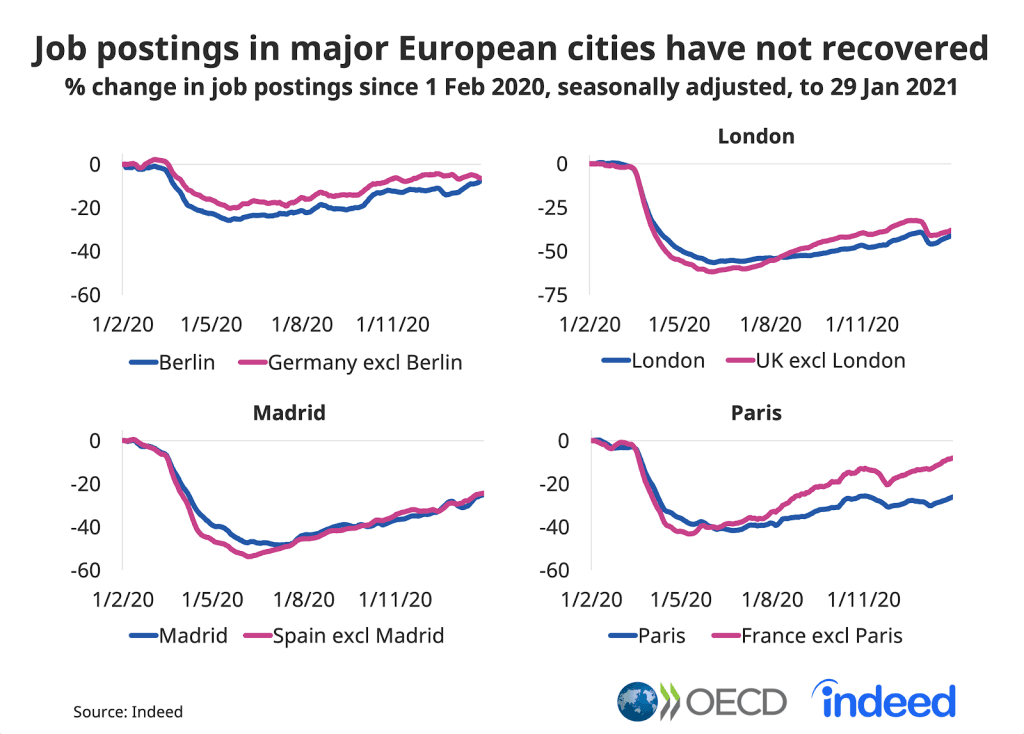
At the lowest point, job postings in London were down 57% on pre-pandemic levels, compared to 48% in Madrid, 42% in Paris and 26% in Berlin. During much of 2020, job postings in these cities were down 5 to 15 percentage points more than the rest of their respective countries.
Job postings still remain far lower than a year ago, down 41% in London, 26% in Paris, 25% in Madrid and 8% in Berlin. London has since narrowed the gap with the rest of the UK, though mainly because postings outside the capital recorded another slump.
Chart: Job postings in major European cities have not recovered
Any persistent decline in economic activity in Europe’s capital cities could prove troubling for countries more widely. In the years before the pandemic, GDP per capita rose by more than 12% in London, Paris, Madrid and Berlin, almost 3 points faster than national growth[3].
Pawel Adrjan, Head of EMEA Research at the global job site Indeed, said: “Remote working will outlast the pandemic, especially in London and Europe’s other major cities, and while greater remote opportunities will benefit millions of people and businesses, it is likely that there will be winners and losers.
“Our research shows that postings for highly-paid remote jobs in cities like London have been more resilient to the pandemic than lower-paid job opportunities in services, which not only risks a difficult adjustment for some urban workers but may aggravate urban inequality.
“While the pandemic is unlikely to eliminate the huge agglomeration benefits and amenities that have drawn people and jobs into big cities for decades, the trends COVID-19 has initiated might weaken those cities’ appeal to some workers, some of whom could already be considering quitting places like London or not returning.
“Real-time data such as online job postings offer very timely information on the situation of local labour markets and offer new insights into underlying trends such as reallocations across sectors or shifts towards new ways of working, including teleworking.”
Lukas Kleine-Rueschkamp, Economist at the Organisation for Economic Co-operation and Development, said: “Our analysis shows that major cities face a difficult adjustment period for their economies and labour markets, with some sectors and occupations having been hit particularly hard by the pandemic.”
“The economic repercussions of the COVID-19 pandemic risks pulling apart urban labour markets, as some jobs and sectors have been relatively well protected during the crisis while others have experienced great difficulty in operating and maintaining their business model.”
“To manage the transition to the post-pandemic world, policy makers need to take actions that support workers at the greatest risk of redundancy or already on short-time work schemes by helping them develop skills aligned to the new demands of their local economy.”
“To mitigate the impact of the labour market adjustment period in major cities, local career guidance should be closely linked to adult learning programmes. Measures should also strengthen the ability of local economies to ‘rewire’ by making it easier for workers to shift industries.”


