

news, resources, technology
How AI is Reshaping the Financial Industry: NVIDIA’s State of AI in Financial Services Survey Highlights
State Of AI In Financial Services,State Of AI In Financial Services’ Survey By NVIDIA
11 Feb 2025

The State of AI in Financial Services survey by NVIDIA reveals how AI is revolutionising financial services, driving higher revenue, lower costs, and new business opportunities. With generative AI adoption soaring (25% of AI applications), firms are leveraging AI for trading, portfolio optimisation, and customer engagement. AI budgets are expanding, with previous financial constraints decreasing by 50%.

The financial services sector is advancing its adoption of artificial intelligence (AI), moving beyond initial experimentation to large-scale implementation. NVIDIA’s latest State of AI in Financial Services report highlights the increasing integration of AI into core business operations, demonstrating improved capability and proficiency across financial institutions.
AI trends in financial services in 2023
Enterprises across industries are accelerating innovation and investment in artificial intelligence (AI) and machine learning (ML), and financial services is no exception. But how are banks, asset managers, insurers, and fintech firms leveraging these advanced technologies, and what impact are they having on business operations?
While NVIDIA collaborates with the entire financial ecosystem—from global banks to fintech startups—to develop AI-powered applications for thousands of use cases, it is essential to understand industry-wide perspectives to maximise AI’s potential.
To achieve this, NVIDIA conducted its third annual “State of AI in Financial Services” survey, gathering insights from approximately 500 financial services professionals worldwide about the latest trends, challenges, and opportunities in AI, ML, and accelerated computing.
The survey results highlight four significant developments in banking, insurance, asset management, and fintech:
- As the global economic landscape faces macroeconomic challenges, financial institutions are turning to AI-driven solutions to enhance risk assessment, streamline operations, and reduce costs.
- Firms are deploying AI-enabled applications at a faster pace. Over 20% of respondents’ companies have integrated AI use cases, and the number of firms considering themselves laggards in AI adoption has declined significantly compared to the previous year.
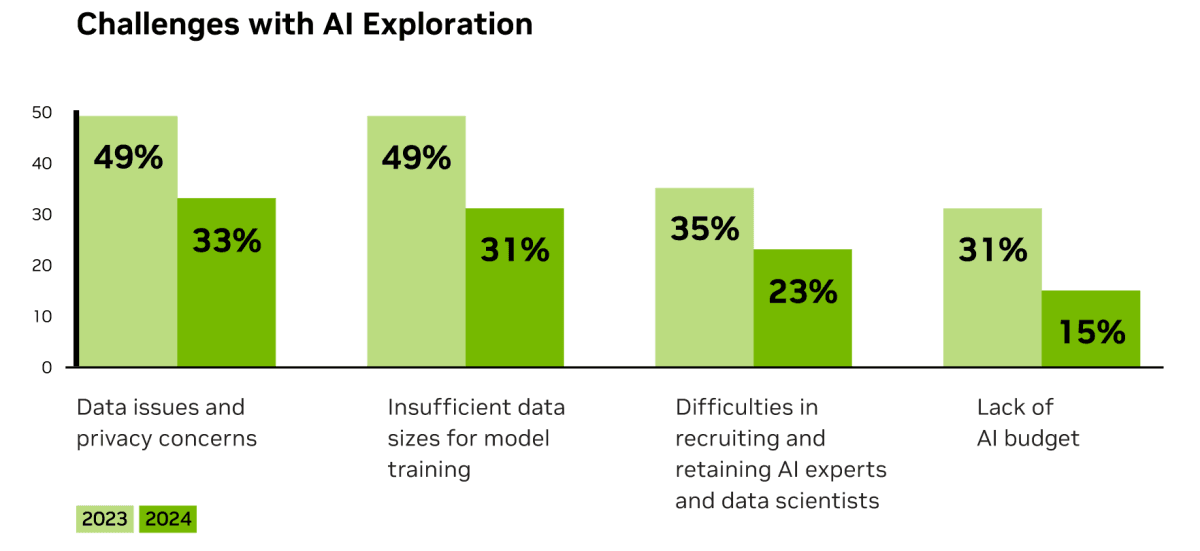
- Recruiting and retaining data scientists has emerged as the biggest challenge to achieving AI objectives. Demand for skilled AI professionals remains exceptionally high.
- Almost half of AI projects now operate on a hybrid infrastructure, making data portability, MLOps management, and software standardisation across cloud and on-premises environments a strategic priority.
AI’s impact on revenue growth and cost reduction
Financial institutions investing in AI are experiencing measurable benefits, particularly in revenue growth and cost savings. According to the survey, nearly 70% of respondents reported that AI contributed to a revenue increase of 5% or more, with a growing number indicating a revenue boost of 10-20%. Simultaneously, over 60% of firms noted that AI implementation has led to cost reductions of at least 5% annually.
In addition to efficiency gains, AI is enabling companies to explore new business opportunities, with nearly a quarter of respondents planning to use AI for developing new revenue streams.
Among the AI applications delivering the highest return on investment (ROI), trading and portfolio optimisation accounted for 25% of responses, followed by customer experience and engagement at 21%. These findings emphasise the tangible financial gains that AI is generating within the industry.
Addressing challenges in AI implementation
Financial firms are increasingly overcoming early challenges associated with AI adoption. Half of management respondents indicated they had deployed their first generative AI service or application, with an additional 28% planning to do so within six months.
Budget constraints, which were previously a significant obstacle, have declined by 50%, reflecting a stronger commitment to AI development. Additionally, concerns related to data availability and privacy are decreasing as firms enhance data management capabilities and expertise.
Improved data handling and increased budget allocation are positioning financial institutions to leverage AI for greater efficiency, security, and innovation across business functions.
Expanding use cases for generative AI
Generative AI has become the second-most-utilised AI workload in financial services, following data analytics. Its applications now extend beyond traditional areas, with a substantial rise in customer experience enhancements, trading optimisation, and portfolio management.
Notably, the adoption of generative AI in customer service has increased significantly, with the use of AI-powered chatbots and virtual assistants rising from 25% to 60%. This growth is attributed to the scalability, cost-effectiveness, and improved accuracy of AI-driven digital assistants.
Over half of surveyed financial professionals are now using generative AI to improve document processing and report generation, enhancing both speed and accuracy.
Financial institutions are also adopting agentic AI—advanced systems that analyse large datasets and apply reasoning to autonomously solve complex, multistep problems. This technology is being used in areas such as risk management, compliance automation, investment strategy optimisation, and personalised customer services.
Building AI infrastructure for future growth
Recognising AI’s transformative potential, financial firms are investing in AI factories—specialised accelerated computing platforms equipped with full-stack AI software. These platforms, implemented either through cloud providers or on-premises infrastructure, enable firms to streamline AI model development and deployment.
By leveraging advanced AI capabilities, institutions aim to enhance customer service, drive revenue growth, and reduce operational costs. With industry leaders forecasting a minimum twofold return on AI investments, financial firms remain committed to implementing high-value AI use cases that drive efficiency and innovation.


