business resources
Employees Lack The Digital Skills Needed To Meet The Demands Of Organisations, Research Reveals

- Cloud-based infrastructure (33%) and cyber security (33%) are the joint highest-rated digital skills that senior business figures believe their organisations most lacks
- Interestingly, 31% feel their firm struggles to integrate new technologies because they don’t have the ‘know-how’ to do so
- High-ranking professionals reveal that the presence of a digital skills gap in UK companies is leading to lower productivity (56%) as well as profitability (37%)
Technology has revolutionised the working world. Organisations are using the capabilities of different technologies to streamline and improve various aspects of their operations and processes. Given the rapid development of existing as well as new technologies, are workers gaining the necessary education and awareness of these technological innovations at the same rate?
Statistics from Accenture worryingly show that employees are lacking the knowledge needed to meet the demands of a digitally driven organisation. They report that this apparent digital skills gaps could cost the UK an astonishing £141 billion in GDP growth over the next ten years.
Interested in the modern workplace, training and qualification provider The Knowledge Academy analysed the latest findings from The Open University, who surveyed 500 senior business figures (chief technology officers, HR directors, HR managers) from across the UK to identify the digital skills they think their organisation is most ‘lacking’ presently. The Knowledge Academy found that the ability to successfully develop and manage a move to cloud-based infrastructure (33%), is one of the two digital skills that senior business figures believe their organisation most lacks.
The other digital skill highlighted by the prominent individuals is inadequate cyber security (33%) competencies. Given how a severe cyber-attack can cripple multiple business functions and compromise sensitive data within a matter of moments – it’s an issue now very high on the agenda for key decision makers in most organisations.
In third position, 31% feel their firm struggles to integrate new technologies and/or data sources to existing business practices because they don’t have the sufficient ‘know-how’ to do so. Slightly below, 30% state digital naivety in their business is stopping them from embracing potentially valuable emerging technologies such as artificial intelligence and automation.
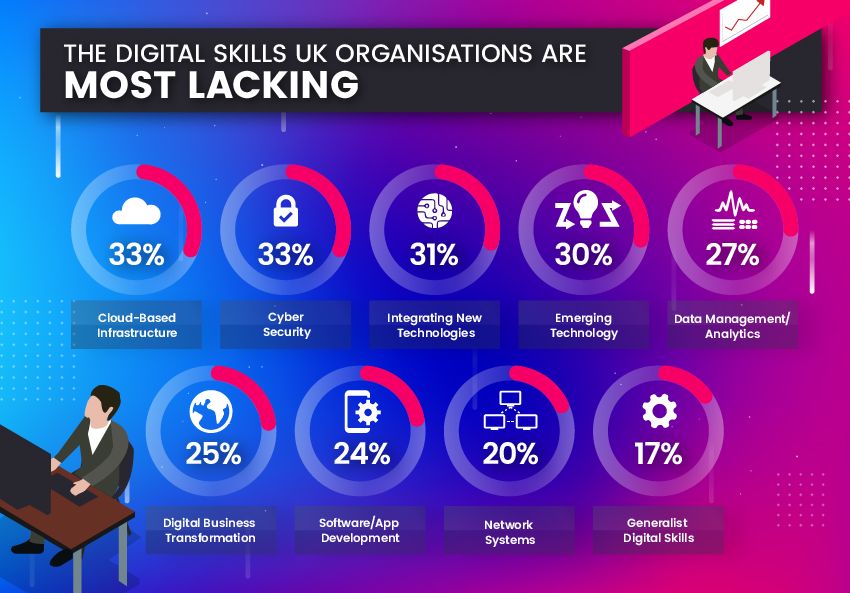 The Digital skills UK organisations are most lacking. Source: The Knowledge Academy
Contrastingly, only 17% of the authoritative professionals say they don’t have enough generalist digital skills in their company. Just above, 20% admit they have an internal shortage of the expertise required to effectively administer and operate network systems.
Additionally, upon further analysis of the study by The Open University, The Knowledge Academy also sought to understand at which level of their organisation do the surveyed senior business figures perceive a lack of digital skills to be most problematic.
From this, The Knowledge Academy discovered that the senior business figures think a digital skills shortage is most problematic in the position of intermediate managers (23%). Subsequently, 20% feel senior managers in their company don’t have the necessary digital proficiency to adapt and adopt to the needed technological changes/advances.
Interestingly, the senior business leaders rank the digital skills deficit of those at director level in their organisation as follows: director (10%), managing director or above (10%) and board level director or partner (9%).
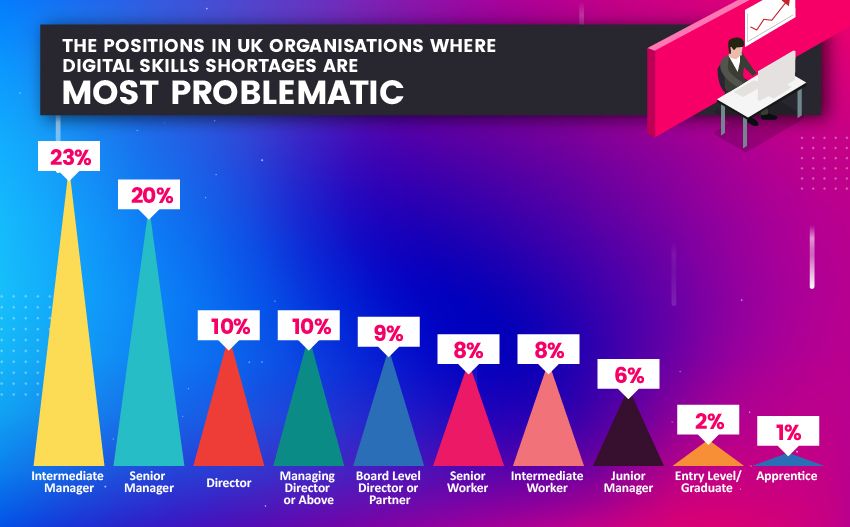
The positions in UK organisations where digital skills shortages are most problematic. Source: The Knowledge Academy
Opposingly, a mere 1% of the high-ranking personnel believe apprentices employed by them have a scarcity when it comes their digital prowess. Whilst, just 2% echo the same sentiments about their entry level workers and graduates.
Furthermore, when questioned, the professionals revealed the ways in which the digital skills gap is negatively affecting their firm’s current performance. They highlighted the following factors:
Decreased productivity (56%), inability to implement time/cost-saving technology (47%), less agile/adaptable (43%), reduced competitiveness (41%) and lower profitability (37%).
Joseph Scott, a spokesperson from the TheKnowledgeAcademy.com commented: “Technology has drastically transformed the working world. It has allowed organisations to conduct and manage various processes/operations in a more efficient manner. Despite this, the consistent evolution of existing technology and the emergence of new technology has made it difficult for employees to stay in line with the technological changes taking place around them. In turn, this has led to a lot of employees not having the required knowledge and skills to implement certain digital practises which can really drive a business forward."
"This research certainly highlights the digital skills UK organisations are most lacking and at which level of the business this digital skills gap is most prevalent. Going forward, senior decision makers should plan and make an active effort to provide the human resource in their organisation the appropriate training on any major digital tool/asset they desire to integrate within their business”, Joseph Scott concluded.
Read More: