business resources
Electron Holography Microscope By Hitachi With Unprecedented Resolution
31 Jul 2024

- Electron holography microscopy is an advanced technique that can be used to visualise magnetic fields in materials at atomic resolution.
- In a recent study, researchers from Japan addressed some key limitations in this technique, achieving a groundbreaking resolution of 0.47 nm when imaging magnetic atomic lattices in a crystal.
- These efforts could pave the way for scientific discoveries in materials science and notable sustainability improvements in electronics, energy generation, and other applied fields.
A research team from Japan, including scientists from Hitachi, Ltd., Kyushu University, RIKEN, and HREM Research Inc., has achieved atomic-scale imaging. Collaborating with the National Institute of Advanced Industrial Science and Technology (AIST) and the National Institute for Materials Science (NIMS), the team utilised Hitachi’s atomic-resolution holography electron microscope to capture magnetic fields within crystalline materials at an unprecedented resolution of 0.47 nanometres. This achievement led to a resolution improvement above the previous record of 0.67 nm, set by Hitachi's previous technology in 2017.
The researchers used unique image capture techniques and improved defocusing correction algorithms to overcome primary obstacles in electron holography microscopy. They greatly decreased noise by automating device operation and performed high-speed image acquisition (10,000 shots in 8.5 hours), resulting in remarkably clear magnetic field photographs. The researchers used unique defocusing correction algorithms to resolve tiny focus changes and remove aberrations from photos. This enabled comprehensive measurements of magnetic field directions and strengths at the atomic level.
Advancements in atomic-scale magnetic field visualisation
Advancements in electronic devices, catalysis, transportation, and energy generation have been prompted by high-performance materials. The qualities of a crystalline substance are mostly dependent on the configuration of atoms and the behaviour of electrons. Particularly significant and frequently used to explain a wide range of unusual physical phenomena are the direction and intensity of magnetic fields at the interfaces between various materials or atomic levels.
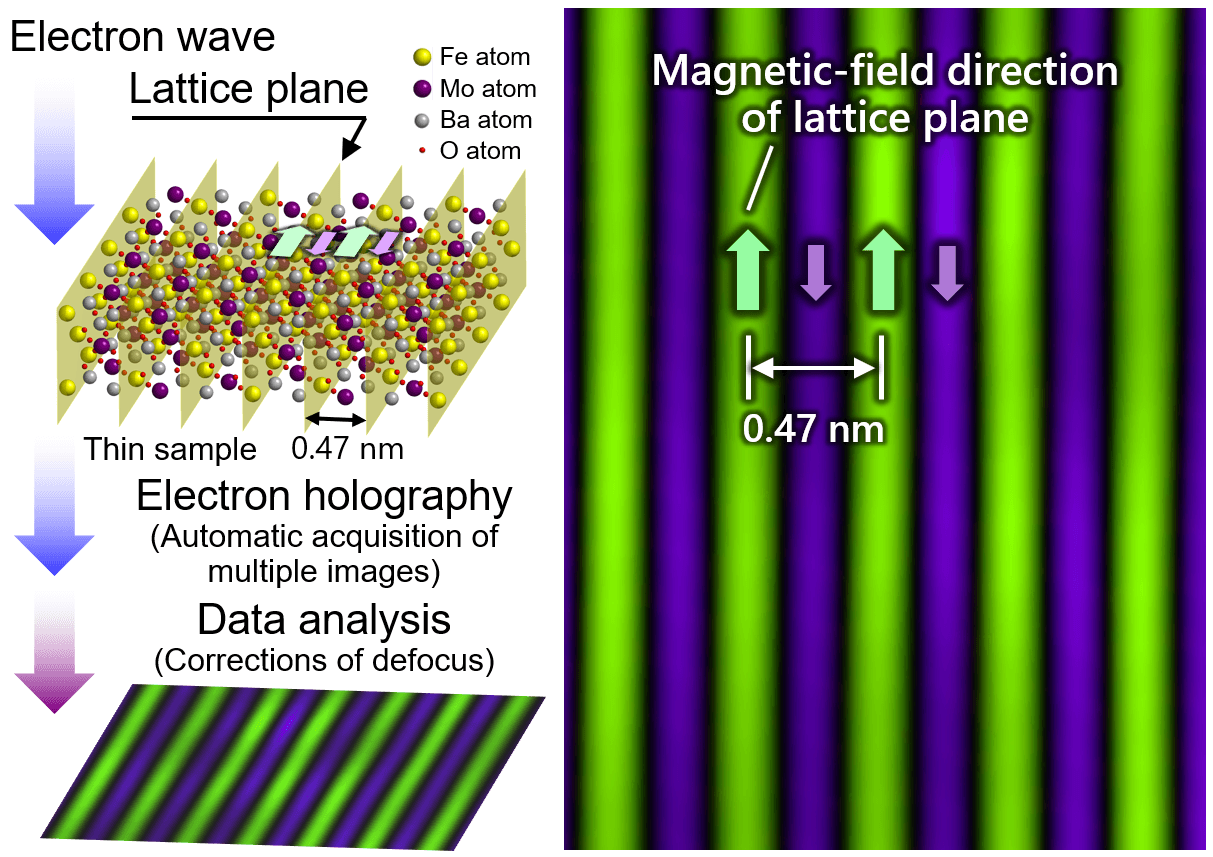
A large collaborative project has now pushed this limit further. Researchers addressed key limitations in Hitachi’s holography electron microscope, and their findings were published in Nature on July 03, 2024.
The team developed a system to automate the control and tuning of the device during data acquisition, speeding up the imaging process to 10,000 images over 8.5 hours. By averaging these images, they reduced noise, obtaining clearer images with distinct electric and magnetic field data.
Electron Holography Microscope by Hitachi: Improved techniques for accurate imaging
The next challenge was correcting minute defocusing, which caused aberrations in the images. Chief Researcher Toshiaki Tanigaki from Hitachi, Ltd. explains:
“We used a method for post-image-capture correction of aberrations, similar to what Dr. Dennis Gabor envisioned when he invented electron holography in 1948. However, until now, there had been no technology for such automated correction in off-axis electron holography.”
The technique corrected defocusing caused by minor focus shifts by analysing reconstructed electron waves. This approach resulted in images free of residual aberrations, making the positions and phases of atoms easily visible with magnetic fields.
Using these innovations, the team performed electron holography measurements on samples of Ba2FeMoO6, a layered crystalline material with distinct magnetic fields in adjacent atomic layers. Comparing their experimental results with simulations, they confirmed surpassing the previous record, observing the magnetic fields of Ba2FeMoO6 at a resolution of 0.47 nm.
Toshiaki remarks: “This result allows us to directly observe the magnetic lattices in specific areas, such as interfaces and grain boundaries, in many materials and devices. Our study is the first step towards investigating many hidden phenomena revealed by electron spin configurations in magnetic materials.”
The team expects their achievement to help solve many scientific and technological challenges.
Toshiaki concludes: “Our atomic-resolution holography electron microscope will be used by various parties, contributing to advances in fields ranging from fundamental physics to next-generation devices. This will help develop high-performance magnets and highly functional materials essential for decarbonisation and energy-saving efforts, paving the way for a carbon-neutral society.”
About Hitachi Ltd.
Hitachi leads the Social Innovation Business, creating a sustainable society through the use of data and technology. The company addresses customers' and society's challenges with Lumada solutions leveraging IT, OT (Operational Technology), and products. Hitachi operates under three business sectors: “Digital Systems & Services,” supporting digital transformation; “Green Energy & Mobility,” contributing to a decarbonised society through energy and railway systems; and “Connective Industries,” connecting products through digital technology to provide solutions in various industries. Led by Digital, Green, and Innovation, Hitachi aims for growth through co-creation with customers.
The company’s revenues for fiscal year 2023 (ended March 31, 2024) totalled 8,564.3 billion yen, with 573 consolidated subsidiaries and approximately 270,000 employees worldwide.