

resources
Annulment vs. Divorce in Pennsylvania: Understanding the Legal Distinctions
16 Jan 2024

“I think you will find that with divorce will come happier remarriages.”

Definition and legal grounds for an annulment in Pennsylvania
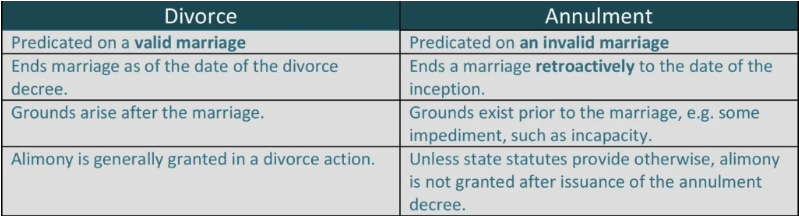
To obtain an annulment in Pennsylvania, you need to prove that it is in accordance with state law. These are marriages that were invalid from the beginning due to prohibited relationships (such as bigamy or incest) or lack of legal capacity (for example, when one party is already married). Annulled marriages may be declared void if certain conditions exist during the wedding ceremony; these include:
- fraud;
- coercion;
- mental incapacity;
- minor age without parental consent;
- impotence of the partner.
It is important to note that unlike divorces, which do not have a time limit for filing post-dissolution documents, Pennsylvania has strict time limits for filing annulment petitions on various grounds. For example, annulment petitions based on fraud must generally be filed within two years of the discovery of the fact. Meanwhile, annulments based on incapacity should generally be considered before the death of one of the parties or within three years of discovery by either spouse. Understanding these legal differences between divorce and annulment can help individuals make informed decisions about which option best suits their circumstances when they seek to dissolve a marriage in Pennsylvania.
Definition and legal grounds for divorce in Pennsylvania
On the basis of fault, one party must prove that a spouse has engaged in certain misconduct that caused the marriage to end. These crimes include:
- adultery;
- cruel treatment;
- abandonment for at least one year;
- bigamy;
- imprisonment for two or more years after the marriage ceremony;
- insanity that resulted in imprisonment for at least 18 months.
On the other hand, Pennsylvania also recognizes no-fault divorces, which do not require proof of wrongdoing by either party. Couples who wish to divorce in this way can seek an irretrievable dissolution of their marriage if they have been living apart without cohabitation for at least one year.
It is important to understand these differences between an annulment and a divorce in Pennsylvania, as they determine different legal procedures and requirements depending on the specific circumstances. Seeking the advice of an experienced attorney who specializes in family law can help individuals navigate this complex process.
Differences in the filing process
To get a divorce in Pennsylvania, you need to file a complaint for divorce with the court. Unlike an annulment, where certain grounds must be proven, a divorce can be obtained on both fault and no-fault grounds. If you choose a no-fault divorce, the spouses can file an application jointly or separately.
Once filed, the annulment and divorce petitions are processed through legal procedures that include discovery, negotiation or mediation, and possibly litigation if the issues cannot be resolved amicably. Seeking the advice of an experienced family law attorney can help individuals effectively navigate these processes.
Consequences for the division of property in annulment cases
In annulment cases, the court considers the division of property. Unlike in divorce cases, where marital property is distributed equitably, in annulment cases, there is usually no automatic right to divide property acquired during the marriage. Each party generally retains its own separate property and any joint assets or debts.
There may be exceptions to this general rule depending on the specific circumstances of the case. For example, if one party can demonstrate that he or she made a significant contribution to the acquisition of a particular asset during the marriage, he or she may have a claim for equitable distribution of that asset even in the event of an annulment.
It is important for individuals considering an annulment in Pennsylvania to understand these differences and to consult with an experienced attorney to help with their particular situation and protect the rights of.

Consideration of alimony
In an annulment case, there is no right to alimony, as it is based on the provision of support after the dissolution of a valid marriage. There may be exceptions if one party can demonstrate that he or she has reasonably suffered economic harm.
It is important for individuals considering a divorce vs. annulment in PA to understand these differences in terms of potential alimony. Consulting with an experienced family law attorney can help to sort through these complex issues and ensure that rights are protected during the process.
Impact on child custody and support
In the case of annulment, the courts tend to focus on determining the legal origin of the children rather than establishing custody arrangements. This means that both parties may need to establish paternity or other legal relationships with their children through separate proceedings.
On the other hand, during divorce proceedings in Pennsylvania, custody and child support are key considerations. The court will prioritize making decisions in the best interests of the child when it comes to determining custody arrangements. Child support guidelines will be applied based on factors such as the income and expenses of each parent.
It is important for individuals considering an annulment or divorce to understand these differences in child custody and the implications for child support.
Timeline and costs associated with annulment and divorce proceedings in Pennsylvania
The timeline and costs associated with annulment and divorce proceedings in Pennsylvania may vary depending on the complexity of the case and whether it is contested or uncontested. Generally, an uncontested divorce, where both parties agree on all issues, can be finalized more quickly than a contested divorce that requires a trial. An uncontested divorce typically takes three to six months to complete, while a contested divorce can take much longer.
In terms of costs, the fees for filing for an annulment and divorce in Pennsylvania are the same. The total cost of a divorce can varies significantly depending on factors such as attorney fees, court costs, mediation fees, and any additional costs associated with property division or child custody issues. It is important for individuals going through any of these processes to carefully assess their financial situation and consult with a family law attorney to fully understand the potential costs.
Understanding the timelines and costs associated with Pennsylvania annulment and divorce proceedings is essential for individuals seeking to dissolve a marriage. We advise you to seek legal advice from an experienced family law attorney who can effectively guide you through these processes while ensuring that your rights are protected.


